

Streamline Your Local Presence with a Comprehensive GMB Audit
A Google Business Profile (GBP) audit systematically checks the elements that drive local visibility, trust, and customer actions. This guide explains what to verify, why each item matters for local SEO, and how to fix issues that reduce discovery and conversions. Many local businesses lose visibility because of inconsistent NAP data, weak reviews, poor visual assets, or guideline violations; auditing addresses those gaps and improves outcomes. You will get a compact, ordered checklist, practical review-response templates, visual content best practices, and a triage table for common listing problems. The steps below are designed for busy local owners and marketers who need an efficient GMB audit process that targets more organic traffic to site and better local conversions.
What Are the Essential Steps in a Google Business Profile Audit?
A GBP audit begins by verifying core business identity, then moves through content, engagement, and compliance checks to protect ranking signals and user trust. Auditing follows an ordered process that captures quick wins first and escalates technical fixes when needed. Use the checklist below as the working sequence for most local businesses performing a GMB audit.
- Verify NAP and website URL accuracy across your site and major citations.
- Confirm primary and secondary categories, attributes, and service listings are correct.
- Check hours, special hours, booking/appointment links, and product/services entries.
- Audit review count, rating trends, and response practices for reputation signals.
- Review photos, videos, and Google Posts for quality, cadence, and CTAs.
- Detect duplicate or unclaimed listings and ensure compliance with Google guidelines.
These ordered steps prioritize signals that affect local ranking and click-through rates, which helps auditors focus on fixes that yield measurable gains.
How Do You Verify NAP Consistency Across Platforms?
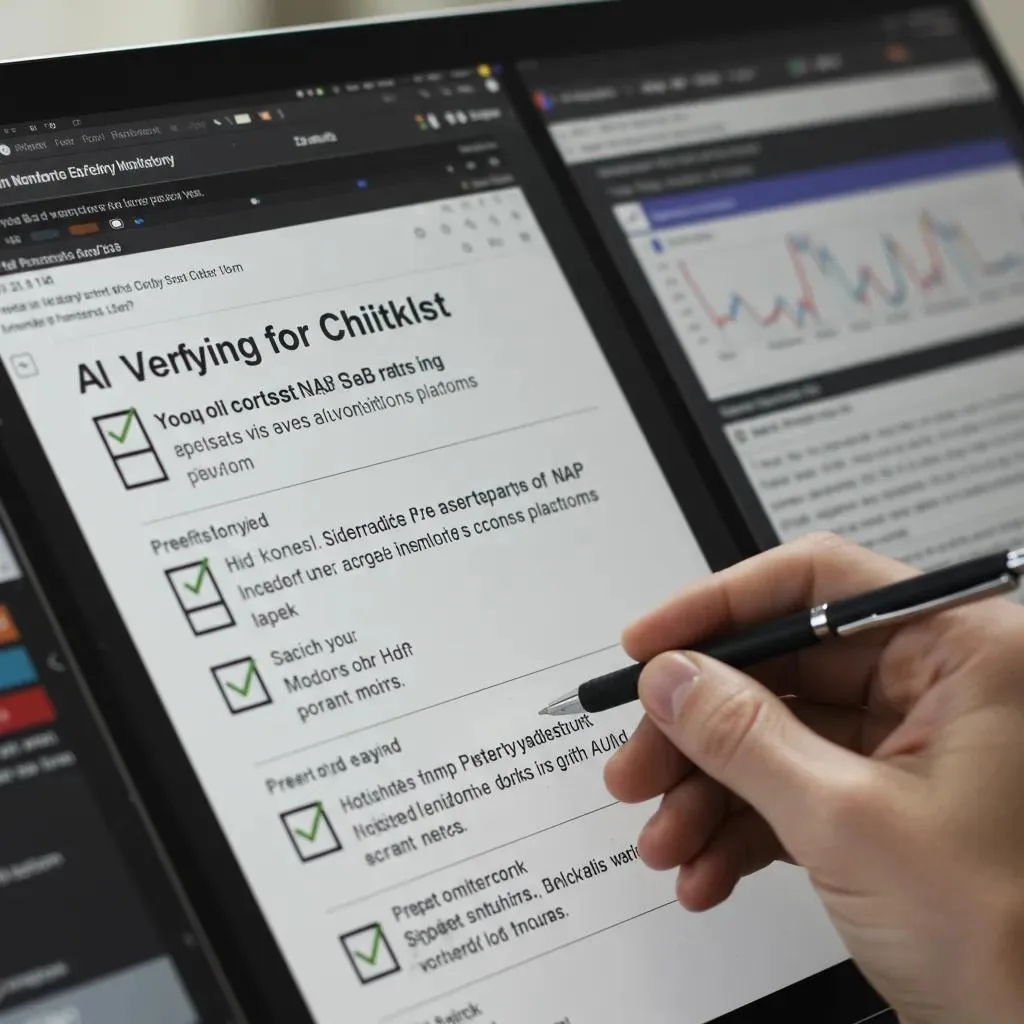
Start by defining your canonical Name, Address, and Phone (NAP) exactly as they should appear to users and search engines. Use manual checks on your website, the GBP dashboard, major directories (e.g., top citation sources), and any social profiles to spot variations in punctuation, abbreviations, and suite numbers. Standardize formatting (avoid inconsistent abbreviations) and document each citation in a simple spreadsheet for record-keeping and change tracking. If you find mismatches, update the source that controls the data first (your website or primary directory), then propagate consistent changes to other listings to minimize conflicts and improve local SEO signals.
Google Business Profile Optimization for Local SEO and Traffic
The Purpose of the presented research is to substantiate the importance of the local optimization of the retailer’s business for search engines to increase organic traffic; to represent insights and give practical recommendations for retailers regarding local optimization of their business in Google as part of an effective marketing strategy; to create the typical valid data micromarking (by the example of the Ukrainian retailer), which will contribute to an advantageous placement in the Local Pack in comparison with competitors, and increase organic traffic and conversion.Methods. To achieve the purpose, the system of general and special research methods are used, including the logical generalization, analysis, comparison and synthesis. To formulate recommendations for retailers, the following online tools are used: Google My Business (to study the specifics of profile), JSON-LD Generator (to generate the data micromarking), Google Structured Data Testing Tool (to verify the validity of data micromarking.
Business optimization in the digital age: Insights and recommendations, A Natorina, 2020
What Key Elements Should You Check in Your GMB Listing?
Beyond NAP, focus on category selection, attributes, hours, services, menu/product entries, and links that drive conversions. Ensure the primary category matches your main service and that secondary categories add relevant context without diluting relevance. Check that attributes (e.g., wheelchair access, payment options) are accurate and that regular and special hours reflect real-world availability. Finally, validate booking or appointment links and the website URL for tracking parameters so clicks and conversions are measurable by analytics.
| Audit Item | Attribute Checked | Pass Criteria |
|---|---|---|
| NAP consistency | Exact match across website and major directories | Exact match across top 5 citations |
| Primary category | Relevance to main business offering | Most specific accurate category selected |
| Website URL & links | Functionality and tracking | Link resolves and analytics capture clicks |
| Hours & attributes | Normal and special hours | Hours reflect actual availability and special dates |
This table summarizes key audit items and what constitutes a pass for each. Use it to grade your listing and prioritize corrections.
Whidbey Digital Marketing can assist local businesses that prefer professional support for a GBP audit. Based in Oak Harbor, the agency emphasizes local expertise, personalized support, and comprehensive SEO strategies that include GBP optimization. If you need an outsourced option that combines on-page, technical, and citation fixes to aim for more organic traffic to site, their services for local businesses include GBP-focused audit work and tracking recommendations.
How Can You Optimize Customer Reviews and Reputation During a GMB Audit?
Review health affects both local ranking and consumer trust; auditing reviews inspects volume, recency, average rating, and sentiment to form a response strategy. Start by measuring review velocity and recent sentiment shifts, then map a response protocol that balances promptness and personalization. Use review responses to reinforce local signals and relevant keywords in a natural tone rather than templated language alone. Handling negative feedback promptly and transparently reduces escalation and demonstrates service recovery to potential customers.
- Measure review metrics: count, average rating, and recent review velocity.
- Establish response SLAs: aim to reply within 48–72 hours for most reviews.
- Create templated frameworks: personalize templates for positive, neutral, and negative reviews.
- Solicit reviews ethically: ask satisfied customers via follow-up messaging or receipts.
A consistent review-management workflow increases review volume and improves perceived trust, which in turn supports higher local click-through rates and conversions.
What Are Best Practices for Managing and Responding to GMB Reviews?

Respond quickly with a tone that acknowledges the customer, states an action or appreciation, and invites offline resolution when needed. For positive reviews, thank the reviewer and highlight a specific product or service to reinforce keywords and service proof points. For negative reviews, acknowledge the issue, apologize when appropriate, outline corrective steps, and offer a private channel to resolve the matter. Keep responses concise, personable, and aligned with brand voice while ensuring the responses include local or service-related context that helps search relevance.
| Review Element | Recommended Standard | Example Target |
|---|---|---|
| Response time | Within 48–72 hours | Respond to 90% of reviews within 72 hours |
| Tone | Personal and solution-oriented | Direct acknowledgment + next step |
| Solicitation | Ethical and opt-in only | Post-service request for feedback via email |
Managing reviews according to these standards improves reputation and signals engagement to search engines and customers alike.
Whidbey Digital Marketing offers managed review-response and reputation services for busy local businesses wanting consistent, professional engagement without internal overhead. Their local expertise and personalized support can help implement templates, SLAs, and escalation paths that align with broader local SEO efforts while aiming to increase local visibility.
How Do You Audit and Improve Visual Content and Google Posts on Your GMB Profile?
Visual assets and posts shape first impressions and influence clicks; auditing them checks quality, relevance, and CTA effectiveness. Assess cover and profile photos for clarity, check filenames and captions for local modifiers, and ensure videos highlight services and team authenticity. Google Posts should follow a regular cadence, use seasonal or event-driven CTAs, and include tracked URLs to measure impact. Together, optimized visuals and posts improve engagement metrics that feed back into local performance.
- Use descriptive filenames and ALT-like captions that include local modifiers.
- Prioritize a high-quality cover photo and frequent, fresh content updates.
- Utilize short videos to showcase services and local context.
These actions produce better engagement signals and clearer user expectations that often translate to higher conversion rates for local searches.
What Are the Best Practices for GMB Photos and Videos?
Upload clear, well-lit images with filenames and captions that reference services and location to create local relevance. Prefer JPEG or PNG within Google’s recommended size ranges and maintain consistent naming conventions like “oak-harbor-[service]-interior.jpg” to connect images semantically to the listing. Rotate photos regularly, emphasize team and service shots, and include short walkthrough videos when possible to increase click-through-to-call or booking actions.
How Should You Use Google Posts to Boost Local Visibility?
Plan posts around offers, events, and timely updates with clear CTAs and tracked URLs for measurement. Maintain a 2–3 week cadence for regular posts and use offer posts for promotions, event posts for time-sensitive items, and update posts for service changes. Track engagement through clicks and conversions to refine post types and timing for maximum local impact.
How Do You Identify and Fix Common GMB Listing Issues for a Healthy Profile?
Common problems include duplicate listings, unclaimed or unverified listings, incorrect categories, and guideline violations; auditing identifies these and prescribes actions to remediate. Detection uses search, citation checks, and specialized tools to surface duplicates and inconsistencies. Remediation ranges from claiming and verifying the canonical listing to requesting merges or removals through support channels when necessary. Prioritize fixes by impact: duplicates and incorrect primary category are high priority because they directly harm discovery.
- Search for name/address variations in Maps and top directories.
- Claim and verify the canonical listing before making broader changes.
- Use structured data on your website to support the correct listing.
This triage approach reduces ranking dilution and aligns citations to a single authoritative profile.
How Can You Detect Duplicate Listings and Ensure Google Guidelines Compliance?
Detect duplicates by searching for variations of your business name, address, or phone number across maps and major directories, and use citation tools for bulk discovery. For removal or merge requests, collect proof of ownership and submit merge requests only when listings represent the same business entity; avoid creating duplicates during the claiming process. Use GBP support and structured LocalBusiness schema on your website to reinforce canonical data and demonstrate guideline compliance.
What Tools and Checklists Help Perform a Comprehensive GMB Listing Health Check?
A combination of citation checkers, duplicate detection tools, and manual GBP Insights review provides a robust toolkit for audits. Use simple spreadsheets for tracking changes, a citation tool for coverage checks, and analytics to verify that GBP clicks are recorded. Offer a downloadable checklist that includes NAP, categories, hours, reviews, photos, posts, duplicates, and verification status to standardize audits.
| Issue | Attribute | Fix Priority |
|---|---|---|
| Duplicate listing | Merge or remove duplicate entries | High |
| Incorrect primary category | Update to most specific category | High |
| Broken website/booking links | Correct URLs and add tracking | Medium |
| Outdated photos | Replace with current, high-quality images | Low |
This triage table helps auditors prioritize fixes that deliver the biggest local SEO and conversion impact.
If you want an expert-assisted GBP check or prefer to outsource the audit, Whidbey Digital Marketing provides local-business-focused GBP optimization as part of its SEO services and offers a free audit option to help businesses pursue more organic traffic to site through targeted GMB improvements.